I saw Children of Men last night, and I think I will be haunted by it for some time.
It is quite possibly the best movie of 2006 (although I have yet to see Guillermo del Toro's Pan's Labyrinth or Pedro Almodovar's Volver, both of which are next on my list--Hispanic filmmakers are having an excellent run right now...And that Alfonso Cuaron and Guillermo del Toro, who are good friends, both have movies that critics love love love is excellent for Mexican filmmakers specifically) and, most certainly, the Blade Runner of our time. I know; that's been said; but this is the dystopian warning film of the early twenty-first century, much as Blade Runner was for the end of the millennium.
I'll endeavor not to reveal spoilers, in this post, and if I do I'll make it known before said spoiling so that you can skip it if you have not yet seen the film--but go see it. Now. Really.
The movie is a virtuosic display of cinematic perfection. Toward the end of the movie, during an intense war scene that could have been pulled from Iraq, I realized that the cinematography within the building consisted mainly of long and uninterrupted takes. There was even blood on the camera lens...And that, I think, is what made me aware of the fact that that was how the movie had been filmed. Long takes: long, beautiful, uninterrupted, perfectly composed takes. One scene, featuring Michael Caine and his character's wife, is framed as though it were a picture, lit with yellow, set to a cover of "Goodbye Ruby Tuesday" (a song which has taken so many new meanings) and it was absolutely stunning. A mini masterpiece, that small snippet of film.
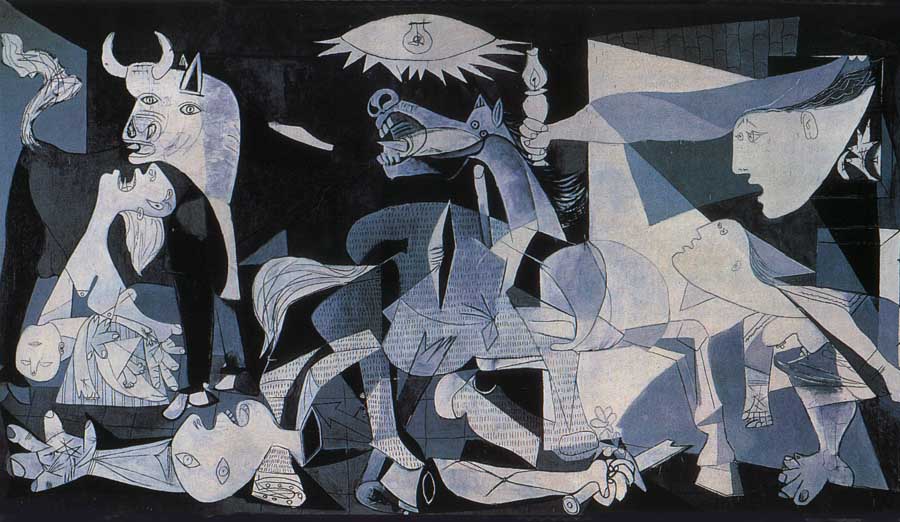
Cuaron's version of the future is masterful. He utilized events of today such infertility scares, terrorism, the so-called immigrant problem and placed then 20 years from now, magnified them to believable proportions. The scenic detail is magnificent: posters advertising the illegality of skipping fertility tests, a striking image of the sign "homeland security," commercials proclaiming the problem of illegal refugees. In one sequence Clive Owens visits his cousin, an advocate for the arts. The cousin has rescued Michelangelo's David from war in Italy; David is missing a leg. Also present in the background of this sequence? Guernica.
And what is so stunning was that this was how Cuaron chose to portray the apocalypse. Humanity is dying: there have been no new births in eighteen years. And yet Cuaron films images of war, terrorist bombs, and refugee camps as though he were calmly observing an idyllic picnic in the park. He makes these scenes beautiful, and that is so terrifying. He forces us to look--not like in the news, where the camera is cutting between so many images that you barely have time to digest the scenes of devastation, and not like in war movies when the action is helter-skelter like a music video on MTV. Cuaron allows us to linger, and this forcing us to evaluate the action with truth and patience is staggering.
The following presents a bit of a spoiler, so continue with care...
At the movie's end there is a scene where Clive Owen's character, Theo, rescues his charge, Kee (Key: even the symbolism, though gently obvious, was presented with such care that you understood its beauty as fate, not cinematic coincidence) from a building under siege. Kee carries with her her newborn child, a girl, and the baby's cries echo through the building, even over the sound of gun shots and screaming. Theo leads Kee through a hall, and the refugees gathered in the hall crowd about Kee and her baby. An African woman, bleeding, hurt, croons a song, and smiles, and behind her another refugee is shot, and dies. The refugees touch Kee, as though she were a Madonna, as though her child were their savior--and the child is their savior. Kee and Theo round a corner, reach the stairwell, and they are met by the British army, and the leader of the squadron hears the baby crying and screams--screams--at his men to stop firing. And quite abruptly everything goes silent.
These soldiers, these men, bleeding, dying, fall absolutely silent and simply stair, aghast, amazed, at this infant. They have not seen a newborn child in eighteen years, and for one moment they lay down their weapons and they are at peace. Life exists within the battle. Kee and Theo exist the building; it is still silent. Two soldiers fall to their knees and cross themselves. Kee does not understand--she is a child and she carries the weight of the world in her arms. The line of soldiers parts, and all stare at this baby, and perhaps for the first time in eighteen years the soldiers--the men--feel something. Immediately, Kee's baby becomes the child of men. For one moment there is absolute peace on a field of battle, glorious silence, the glimmer of possibility, the presence of hope and life.
And then a bombshell erupts, and reality returns, and the world resumes its chaotic, horrible, desperate turn.
I have never seen anything like that in a film. I would see the movie again, just to experience that sequence one more time. The encountering of cinematic perfection is extraordinarily rare (Schindler's List is probably the only movie that achieves it, in my opinion) and it is present, here, in Children of Men.
In all honesty our world is falling apart. When I blog it is usually about pop culture, petty things, ridiculousness...because, in all honesty, art is one of the few things that has the ability to move me anymore. Theatre, music, movies, books, a wonderful painting. I am desensitized and cold and here, in Cuaron's vision of the future, is a truth that moves me more than anything I see on the news--because it is the news. It is Iraq, Darfur, Israel, New York. The world has the potential to become nothing more than a war zone.
I close my emotions to this reality because the gravity of right here right now is too much to bear. The news edits are rapid and fast: snippets of horror and genocide, terrorism and pain. I look I read I am aware, but the world moves too quickly for me--for us--to consider, to study, to feel.
Children of Men allows the viewer to look, to consider, to fucking scrutinize what is going on in our world right now. The film ends hopefully (but the hope is only a glimmer) and there is still hope. Cuaron demonstrated peace in a war zone, peace brought by a child--momentary peace, yes, but a pause nonetheless. Caesura.
I am trying to end this eloquently. It isn't going to happen. I just ask that you see Children of Men, and pause, and consider, and perhaps linger a bit longer at the news, the paper, the presence of despair and hope, the glimmer of possibility.


Subscribe to:
Post Comments (Atom)
No comments:
Post a Comment